

1 min read
Off the Grid on Landfill Gas: How ESI Built an Islanded Power Plant for a Data Center
Admin : Published
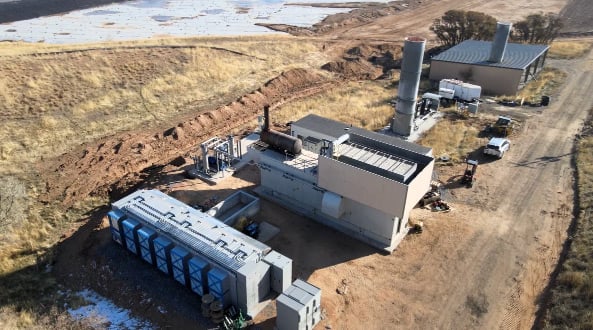
Most landfill gas generators lean on the utility grid. The grid sets voltage and frequency, and the engine follows. ESI commissioned a project that doesn’t require the grid for support.
At a landfill gas site, ESI completed the engineering, procurement, construction, and commissioning of a landfill-gas-to-energy (LFGTE) plant that powers a small data center. The site can run fully islanded, disconnected from the grid.
Why islanded operation is hardOn a grid-tied machine, the utility handles the heavy lifting for power quality. In an islanded configuration, the generator carries that burden alone. It has to establish and maintain its own voltage and frequency every second, with no outside reference.
Load changes are the risk. A large block of load coming on or dropping off all at once can pull the engine off speed and push frequency or voltage out of range. For a data center, that is unacceptable. Stability and control became the central engineering problem.
The fix lives in the controls
ESI developed a custom load-shedding control scheme for the generator. Instead of applying full load changes to the machine, the system brings loads on and off in gradual steps. Each step is small enough for the engine to absorb without losing speed or voltage control.
The result is power quality that meets the data center's requirements, delivered entirely from renewable landfill gas.
What ESI delivered
ESI handled the full mechanical, electrical, and controls scope. On the generator side, the team:
- Purchased a containerized CAT 3520 generator set.
- Swapped in a rebuilt generator.
- Upgraded all ancillary components.
- Engineered and implemented a custom control method for islanded operation.
What it means for the owner
The owner received a data center powered by renewable energy generated on-site from landfill gas that was previously unused. The project reduced reliance on purchased utility power and lowers energy costs.
It also shows that islanded biogas generation can support a power-sensitive load when stability is engineered into the controls rather than borrowed from the grid.
Talk to ESI
ESI designs, builds, and maintains landfill gas and biogas energy systems, from the engine to the controls. If you are weighing on-site power from landfill gas, contact ESI to discuss your site.